
Elon Musk isn’t exactly known for playing it safe with his words—or his memes. But when he referred to one of the most powerful scientific tools on Earth as “demonic technology,” even longtime followers were caught off guard. The comment, half-joke and half-ominous, didn’t just entertain Musk’s usual crowd. It reopened old internet rabbit holes about a machine some once feared could end the world.
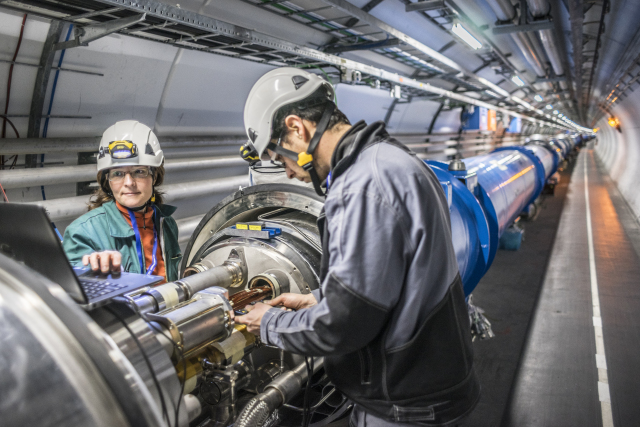
Buried deep beneath the border of Switzerland and France lies a massive ring of metal and magnets stretching 17 miles across. It’s hailed as one of science’s greatest achievements—and also one of its most misunderstood. For years, it’s been a magnet for awe, anxiety, and conspiracy theories. Now, thanks to one viral post, it’s trending all over again. So what exactly is this mysterious “death machine”? And why are people still so divided over what it can do?
A Collider Born from Curiosity
Long before it became a trending topic for the wrong reasons, the Large Hadron Collider (LHC) was a triumph of scientific ambition. Conceived by the European Organization for Nuclear Research—better known as CERN—the collider was built to answer some of the most fundamental questions about our universe. What gives particles their mass? How did the universe begin? What is dark matter made of? These are the mysteries that pushed over 10,000 scientists from around 100 countries to collaborate on something unprecedented.

Image Credits: Website @CERN
Nestled in a 17-mile underground ring near Geneva, Switzerland, the LHC began operations in 2008 after a decade of intense construction. Its purpose sounds like science fiction but is firmly rooted in real physics: smash particles together at nearly the speed of light and analyze what emerges from the wreckage. In doing so, scientists can observe forces and particles that only existed moments after the Big Bang.
The machine doesn’t just break particles—it breaks ground. In 2012, it helped confirm the existence of the Higgs boson, a particle so elusive that it had been nicknamed the “God particle.” This discovery filled in a critical blank in the Standard Model of physics and won researchers a Nobel Prize. In essence, the LHC wasn’t built to destroy anything—it was built to understand everything.
The Higgs Boson and Other Scientific Breakthroughs

Image Credits: Website @CERN
When scientists fired up the Large Hadron Collider in 2008, they weren’t chasing headlines—they were chasing the unknown. Their most celebrated prize came in 2012 with the discovery of the Higgs boson, a particle that helps explain why other particles have mass. It was a moment decades in the making, finally confirming a theory first proposed by physicist Peter Higgs in the 1960s. Without the Higgs field—and the particle linked to it—the very structure of matter as we know it wouldn’t hold up.
But the Higgs boson is just the tip of the collider’s iceberg. Over the years, the LHC has enabled scientists to test aspects of the Standard Model of particle physics with unprecedented precision. It’s helped rule out or narrow down theories about supersymmetry, dark matter, and the very fabric of space-time. Each collision in that underground ring creates a brief, chaotic event that mirrors the energy levels of the early universe—and in that chaos, scientists find clarity.
Beyond the physics, the collider’s breakthroughs also show the power of global collaboration. Thousands of researchers from around the world share data and findings, pushing humanity’s understanding of the universe one step further. It’s messy, complicated, often imperfect science—but it’s progress. And in a world full of misinformation, that progress often gets overshadowed by fear.
Musk’s Meme and the Spark of Conspiracy
It was just one meme—sarcastic, cheeky, and barely a sentence long. But when Elon Musk posted in 2022, “Please let me use the CERN Large Hadron Collider. I am normal and can be trusted with a demonic technology unlike anything the world has ever seen,” the internet did what it does best: spiral. Some laughed. Others squinted. A few dug up every half-buried fear that had ever been associated with the world’s most powerful particle accelerator.
The post went viral instantly. Musk’s massive online following gave the comment legs, whether or not it was meant to be taken seriously. But it wasn’t just about the joke—it was about who was making it. As the head of companies pushing the boundaries of space, AI, and neural interfaces, Musk isn’t just a meme-lord; he’s a technologist whose words carry real-world weight. And when someone of that stature calls a scientific device “demonic,” even in jest, it hits differently.
What followed wasn’t entirely new, but it did gain renewed momentum. Online forums and conspiracy hubs dusted off old claims that the collider could destroy the planet, open portals to parallel universes, or trigger events humanity wasn’t ready for. Memes collided with fear, and suddenly, the “death machine” narrative was trending again—this time with a familiar face fueling the fire.
From Portals to Demons

For some, the Large Hadron Collider is a feat of human ingenuity. For others, it’s a mysterious machine that opens literal and figurative doors we were never meant to touch. Ever since it first powered on, the LHC has been wrapped in conspiracy theories—some laughably bizarre, others alarmingly persistent. These theories don’t just question the science; they tap into a deeper cultural unease about what happens when humans wield technology they barely understand.
One of the more enduring claims is that CERN is playing with forces beyond our realm—literally. Some fear that high-energy particle collisions could tear holes in space-time or open gateways to parallel universes. While that makes for great science fiction, actual physicists have thoroughly debunked such scenarios. Even in the most extreme cases, any black holes created in the collider would be microscopic and vanish instantly, posing no threat whatsoever.
Then there’s the claim that CERN is linked to the occult. Much of this stems from the organization’s logo, which some insist resembles “666,” the so-called number of the beast. Add to that the large Shiva statue standing outside CERN’s headquarters—a gift from India symbolizing the cosmic dance of creation and destruction—and you’ve got a perfect storm for internet mythmaking. In 2016, a prank video showing a staged “ritual” at the site only added fuel to the fire, despite CERN confirming it was an internal joke gone wrong.
Why Experts Aren’t Worried

Image Credits: Website @CERN
While online speculation spins wild tales of cosmic danger, the scientific community has been clear and consistent: the Large Hadron Collider is safe. It’s not a portal-opener, a black hole generator, or a doomsday device—it’s a research tool. One that operates under the tightest safety protocols and decades of peer-reviewed physics. If there were even a remote chance that it could end life as we know it, it would have never been built.
Physicists working on the project often find themselves playing myth-busters more than they’d like. The notion that the LHC could create a black hole capable of swallowing the Earth sounds terrifying—but it defies actual physics. Yes, high-energy collisions happen, but the energy levels are still minuscule compared to natural cosmic rays that strike Earth’s atmosphere daily. If black holes from particle collisions were a threat, the planet would’ve disappeared long before the LHC was even a blueprint.
Experts also emphasize that the machine isn’t operating in secret or outside of public oversight. CERN is one of the most transparent research organizations in the world, frequently publishing its data and findings. Public tours, open lectures, and a global collaborative team ensure that what happens underground isn’t hidden behind a curtain of mystery—it’s just extremely technical.
When Influence Meets Misinformation

In today’s hyperconnected world, the line between a joke and a belief system can dissolve in a matter of minutes. And when someone with Elon Musk’s level of influence weighs in—even sarcastically—it doesn’t take much for the internet to run wild. His meme may have been a one-liner, but it was enough to breathe new life into fringe theories that have been simmering for years. That’s the strange power of digital culture: memes are no longer just jokes—they’re micro-broadcasts with real-world consequences.
Musk, whether intentionally or not, acts as a catalyst. His reputation as a tech visionary means that when he speaks—even in jest—people listen. Some take it as entertainment. Others take it as evidence. In this case, a meme about “demonic technology” helped revive dormant fears about the LHC, turning old conspiracy theories into trending topics all over again. Even if Musk wasn’t serious, plenty of people were.
This moment underscores a broader truth about the age of information: influence can be a double-edged sword. Public figures have the ability to inform and inspire, but they also have the capacity to distort. And when complex science meets cryptic social media, facts often get flattened into fear. The result is a cycle where satire becomes suspicion, and memes become movements—whether based in truth or not.
A Culture of Fear vs. the Future of Discovery
There’s something almost poetic about the fact that the same machine designed to unlock the secrets of the universe is often seen as a threat to it. The Large Hadron Collider represents humankind at its most curious—driven to understand the forces that shape existence itself. But curiosity doesn’t always translate to comfort. When people don’t fully grasp what a machine does, or why it matters, fear can step in to fill the void.
That fear isn’t irrational—it’s human. We’ve seen powerful technologies cause both breakthroughs and breakdowns. From AI to nuclear energy, each leap forward seems to come with its own set of anxieties. The LHC, buried underground and operating at incomprehensible speeds, easily becomes a symbol of that tension. For many, it’s not just about what the machine is, but what it represents: a world moving faster than we can emotionally or ethically process.
Still, it’s worth remembering that most scientific progress has historically faced resistance. Galileo’s telescope sparked outrage. Electricity was once viewed as dangerous magic. Even vaccines have had their skeptics. The LHC is part of that long lineage—a moment in history where fear and fascination collide. And while it’s important to ask tough questions, it’s equally important to allow facts to rise above the noise.
How to Think Critically About Scientific Controversies
When science meets the public, misunderstandings are inevitable—but they don’t have to be permanent. Here are some grounded ways to approach controversial scientific topics with clarity instead of confusion:
1. Start with the Source
Before sharing or reacting to bold claims, check where the information originated. Is it from a peer-reviewed journal? A meme? A reliable news outlet? Scientific credibility usually comes from transparent research, not viral posts.
2. Understand the Language of Uncertainty
Science doesn’t deal in absolutes—it deals in probabilities and evolving theories. Phrases like “some scientists believe” or “preliminary data suggests” don’t mean the science is shaky; they mean it’s honest.
3. Question the Sensational
If a headline sounds too wild to be true, it might be. Claims that a machine can “destroy the Earth” or “open portals to other dimensions” are often exaggerated to drive clicks—not based on credible science.
4. Separate Jokes from Journalism
Public figures, especially those with huge platforms, often speak in irony or memes. Take note of tone and context. A sarcastic tweet shouldn’t be treated as a technical endorsement or warning.
5. Look for Expert Consensus
One loud voice doesn’t outweigh a hundred quiet experts. Look at what the broader scientific community is saying—not just the flashiest opinion. True breakthroughs and warnings tend to come with consensus.
6. Learn the Basics (Even Briefly)
You don’t need a physics degree to understand core concepts. Watching a 5-minute explainer on how particle accelerators work can go a long way in separating science from sci-fi.
7. Don’t Confuse Symbolism with Intent
Seeing a statue or logo and jumping to symbolic conclusions is tempting—but dangerous. The presence of a Shiva statue at CERN isn’t proof of occult rituals. It’s cultural appreciation, not conspiracy.
8. Recognize Your Bias
We all bring personal fears, beliefs, and media habits into how we interpret news. Being aware of your own filters helps you stay grounded when a story sparks strong emotions.
9. Ask: Who Benefits from the Fear?
Sometimes, panic is profitable. Content creators, influencers, or even media outlets may exaggerate danger because fear drives engagement. When in doubt, follow the money—or the motive.
10. Stay Curious, Not Cynical
It’s okay to ask questions, even tough ones. But there’s a difference between healthy skepticism and automatic disbelief. Being open-minded means staying grounded in both wonder and evidence.
What This Really Says About Us
Elon Musk’s meme didn’t break the internet—but it did crack open a larger conversation about how we, as a society, respond to powerful technology. The Large Hadron Collider is a marvel of modern science, a tool designed to expand the boundaries of human knowledge. And yet, its very complexity makes it a magnet for fear, myth, and memes. Musk’s offhand comment lit a match—one that quickly reignited long-dormant fears and online conspiracies.
But maybe that’s the bigger takeaway here. The issue isn’t just about a machine under Geneva or the billionaire who joked about it—it’s about us. About how quickly information, or misinformation, spreads. About how much influence public figures hold in shaping our beliefs. And about how curiosity, if not nurtured, can so easily turn into confusion.
As we stand at the crossroads of science, technology, and public discourse, we’re faced with a choice: react with fear, or respond with understanding. Ask the hard questions—but listen to the answers grounded in fact. Share your theories—but also seek the truth behind them. Because the next time something powerful comes along—and it will—it’s not just the technology we’ll need to trust. It’s ourselves.
