
Every scar tells a story—but not every story is heard. For children who undergo life-saving medical procedures, the scars can become more than a physical reminder—they can shape how they see themselves. Studies have shown that visible differences, especially on the face or head, can impact a child’s self-esteem and social confidence. Now imagine being a young boy recovering from brain surgery, carrying not only the weight of a diagnosis but also the stares and whispers that come with a prominent scar.
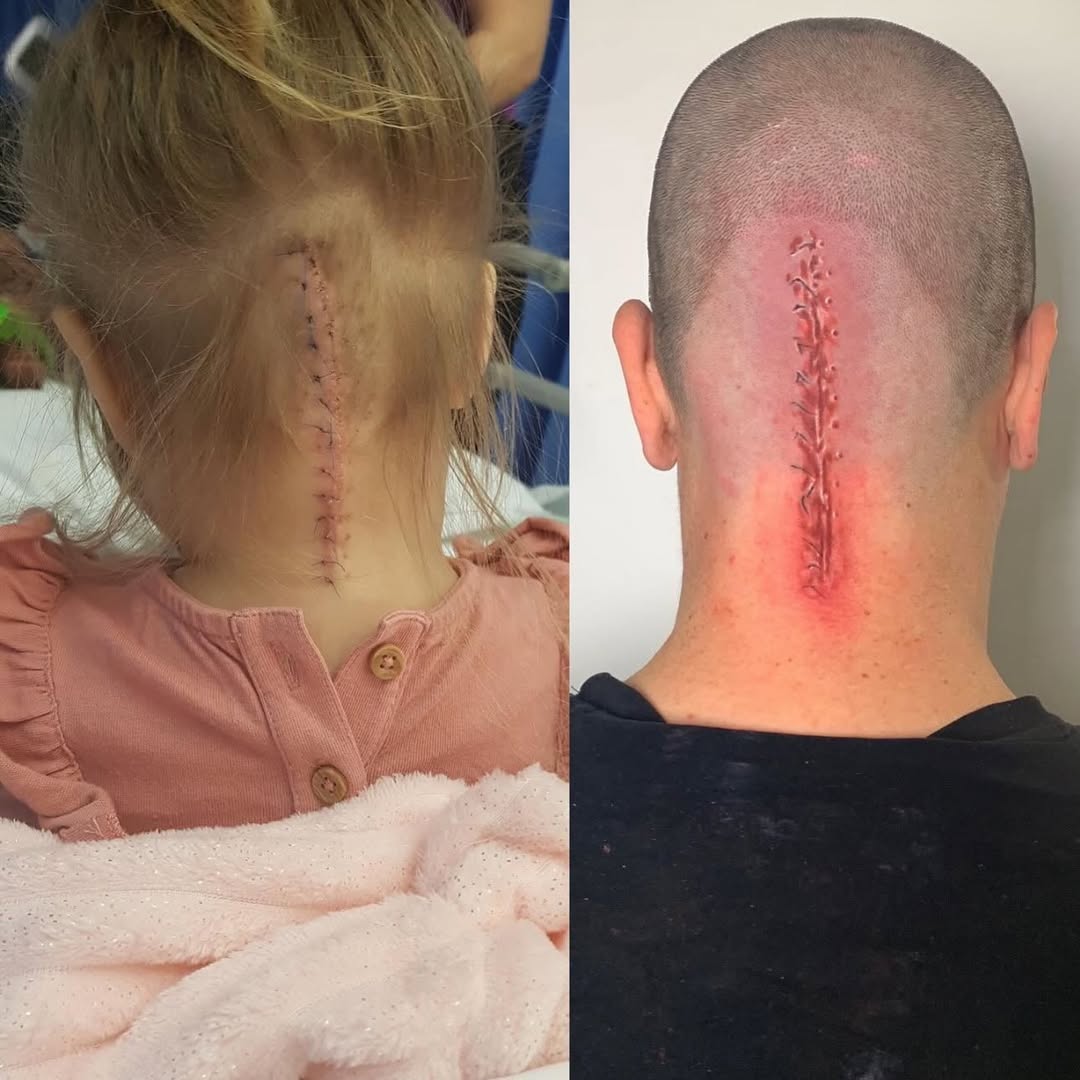
That’s the world one father saw his son navigating—and decided to change it with ink and empathy. Instead of offering empty reassurances, he sat in a tattoo chair and had his son’s scar replicated on his own scalp. A permanent show of solidarity. A visual way of saying, “We’re in this together.” The act was quiet, simple—and it resonated with millions.
As the image of their matching heads swept across the internet, it struck a nerve far deeper than most viral moments. It wasn’t about shock or spectacle. It was about the power of presence, the kind of support that doesn’t ask for words. And in that simple gesture, one dad rewrote what it means to show up for someone you love.
A Mark Of Love: A Father’s Bold Gesture
When 8-year-old Gabriel Marshall from Kansas looked in the mirror after undergoing brain surgery, he wasn’t just seeing a physical scar—he was staring at a reminder of everything he had been through. A child shouldn’t have to wrestle with feeling different or “less than,” especially after surviving something as traumatic as a brain tumor. But for Gabriel, the scar that curved across his scalp became more than a medical artifact. It started to define how he saw himself. He once told his father that he felt like a “monster.” It was a heartbreaking reflection of how a child’s inner world can absorb the unspoken judgments of the world around them.
Gabriel’s father, Josh Marshall, knew he couldn’t erase what had happened to his son, nor could he take away the emotional toll it left behind. But he could meet his son in that vulnerable place and walk alongside him. Rather than offering platitudes or trying to distract him from the pain, Josh decided to face it head-on—literally. He got a tattoo on his own scalp that perfectly mimicked his son’s surgical scar. This act wasn’t cosmetic or performative. It was a deeply personal expression of empathy and solidarity, a way to say, without words, “You are not alone in this.” The tattoo turned his body into a canvas for his son’s struggle—and his strength.
The photo of father and son, both bald and marked in the same way, quickly made its way across social media. What set this image apart from countless others was the authenticity of the moment it captured. There was no dramatic backdrop, no orchestrated lighting—just a father making a visible, permanent statement of support. The tattoo wasn’t about shock value. It was about being seen and making someone else feel seen in the process. And for Gabriel, that meant the world. What had once made him feel isolated now became a point of connection—a shared identity built not from scars, but from love.

Image via https://www.instagram.com/unv4ulted/
The Story Behind The Scar
Gabriel’s journey into the world of hospitals and scalpels began when doctors diagnosed him with anaplastic astrocytoma, a rare and aggressive type of brain tumor. Surgery was necessary to remove the mass, and with it came the inevitable scar that would become a fixture on his head. But while the tumor was successfully removed and Gabriel’s prognosis was hopeful, the psychological healing would take much longer. Recovery from cancer isn’t only about the body—it’s about piecing together a sense of normalcy in a life that has been irrevocably altered. For a young boy navigating school, friendships, and growing up, the scar was not just a medical marker; it was a social one.
Children are remarkably perceptive, and Gabriel soon became aware of how his appearance set him apart. The stares, the questions, the quiet glances in public—they all became part of his daily experience. The scar started to feel like a label he couldn’t remove, and slowly, it began shaping his self-concept in painful ways. That moment when he told his dad he felt like a “monster” wasn’t just about vanity or discomfort. It was a window into how deeply children internalize the reactions they get from the outside world. Experts in pediatric psychology have long emphasized that visible medical differences, especially in facial or cranial areas, often carry a profound emotional impact on children, influencing their sense of identity, worth, and belonging.
Seeing this transformation in his son, Josh refused to let the scar define Gabriel in a negative light. His solution wasn’t to hide the mark or ask Gabriel to pretend it didn’t matter. Instead, he redefined its meaning. By replicating the scar with a tattoo, he turned what felt like a source of shame into a shared symbol of survival. He showed Gabriel that this part of his story could be reframed—not as a flaw, but as a feature of resilience. Through this gesture, Josh didn’t just honor his son’s strength—he amplified it. And in doing so, he offered a new lens through which Gabriel could view himself: not as damaged, but as deeply loved.

Image via https://www.instagram.com/unv4ulted/
A Father’s Way Of Saying “You’re Not Alone”
Josh’s decision to get a tattoo matching his son’s scar was not made on a whim. It was born from a moment of heartbreak, yes, but also from a profound sense of purpose. When he heard his son describe himself as a monster, something shifted. For a parent, those words land like a thunderclap—a reminder of the emotional wounds that are often harder to see than the physical ones. Josh understood that telling Gabriel he was beautiful and strong wasn’t enough. He needed to show him. He needed to wear that story on his own skin, to mirror not just the scar, but the experience behind it.
The moment Gabriel saw the tattoo on his father’s head, something changed. He smiled—not a forced or hesitant smile, but the kind that reflects deep recognition. It was as if Josh had reached into Gabriel’s world and pulled him back into a place of connection. The scar no longer separated them; it united them. Josh’s tattoo became a living testament to the idea that true love means meeting someone in their pain and choosing to carry it with them. And for Gabriel, that changed the narrative. He was no longer just the kid with the scar—he was the boy whose dad wore it too.
When the photo of Josh and Gabriel circulated online and was entered into the St. Baldrick’s Foundation’s “Best Bald Dad” contest, it didn’t win first place—but it did win something far more enduring: the admiration of strangers and the affirmation of a community. The post went viral because it wasn’t just a picture—it was a message. A message that real strength isn’t found in muscles or medals, but in vulnerability and shared humanity. Josh’s act of tattooing his head wasn’t about bravery in the traditional sense. It was about choosing connection in the face of pain. And that choice rippled outward, touching people far beyond their Kansas hometown.
Why This Story Resonated With Millions
What made this story go viral wasn’t spectacle or celebrity—it was sincerity. In a world oversaturated with curated content and carefully staged moments, the raw honesty of Josh and Gabriel’s photo stood out. There was nothing glossy or manufactured about it. It was just a father and son, their heads side by side, both bearing the same mark. But in that quiet symmetry, people saw something powerful. It reminded them of the kind of love that shows up without being asked, that acts instead of simply offering words. It was a rare moment of internet virality that carried substance, not just sentiment.
Millions responded because the story taps into universal themes: the desire to be seen, the fear of standing out for the wrong reasons, and the healing power of human connection. Scars—whether physical, emotional, or both—are part of everyone’s story. And yet, so often, society urges us to hide them, cover them, forget them. Josh did the opposite. He spotlighted the scar and gave it dignity. He made it something worth replicating, not hiding. In doing so, he challenged deeply ingrained ideas about beauty, strength, and masculinity—showing that vulnerability can be a source of power, not weakness.
The public reaction also opened a wider conversation about parenting, empathy, and the importance of active support. Many parents shared similar stories in the comments—moments when they had struggled to help their children navigate illness, trauma, or bullying. Josh’s tattoo became more than a personal symbol. It became a touchpoint for families around the world who had faced similar pain. The image sparked not just likes, but letters, phone calls, and reflections. In a way, it helped people remember that simple, deeply human gestures still matter—and that they can carry far more weight than any viral trend.
Scars, Stigma, And Self-Esteem: What Experts Say
Scars are often viewed through a purely physical lens, but their emotional weight—especially in children—can be profound. According to Dr. Michelle Pearlman, a pediatric psychologist, children who live with visible differences often internalize those differences as flaws, even when caregivers do their best to support them. “Children look to adults to understand how to process their experiences,” she explains. “When a parent actively affirms a child’s difference instead of ignoring or downplaying it, that child learns resilience, not shame.” In Gabriel’s case, his father’s tattoo served as that affirmation—one more powerful than words alone could ever provide.
The stigma around visible medical conditions remains a significant barrier to mental wellness, especially in younger populations. Studies published in the Journal of Pediatric Psychology confirm that children with facial scarring or cranial deformities experience higher rates of peer rejection, anxiety, and lowered self-esteem. These challenges often persist into adolescence and adulthood, making early intervention and emotional support essential. That’s why gestures like Josh’s carry weight beyond the immediate moment. They become emotional anchors—reminders to the child that they are valued, protected, and worthy, just as they are.
Experts suggest that symbolic acts—whether through storytelling, visual representation, or physical action—can dramatically reshape a child’s narrative about their own body. Tattoos, for example, can serve as both metaphor and message. In this context, Josh’s tattoo told his son: “Your experience is meaningful. You are not broken. And I will wear this with you.” While not every parent will choose such a visible path, the underlying principle remains the same: children thrive when they feel deeply seen. And often, that visibility begins with a parent who is willing to meet them exactly where they are.
Small Acts, Big Meaning: The Lasting Message
Josh Marshall’s tattoo may be permanent, but its meaning continues to evolve. What began as a father’s response to his son’s pain has grown into something much bigger: a symbol of unconditional love, of the lengths parents will go to remind their children of their worth. The ink etched into Josh’s scalp is no longer just a line—it’s a message, one that says, “You matter, exactly as you are.” And for a child navigating the complex emotions of illness and recovery, that message is everything.
The story reminds us that the most profound expressions of love often come in the smallest, most unexpected forms. A quiet act. A physical mark. A willingness to sit beside someone in their struggle without needing to fix or change it. That’s what Josh did. He didn’t try to erase his son’s experience—he honored it. He made it visible. And by doing so, he gave Gabriel a mirror in which he could see not just survival, but strength. He gave him a new story to tell when someone asked about his scar—one that includes love, courage, and the kind of father who doesn’t just show up, but stays.
In a world that too often rewards appearance over authenticity, this story cuts through. It shows that resilience doesn’t always look like victory laps or finish lines. Sometimes, it looks like two bald heads, side by side, one marked by surgery, the other by choice. And sometimes, it’s those small, deeply personal acts that leave the biggest mark—on a child’s heart, on a family’s bond, and on anyone lucky enough to witness them.
Featured Image via https://www.instagram.com/unv4ulted/
