
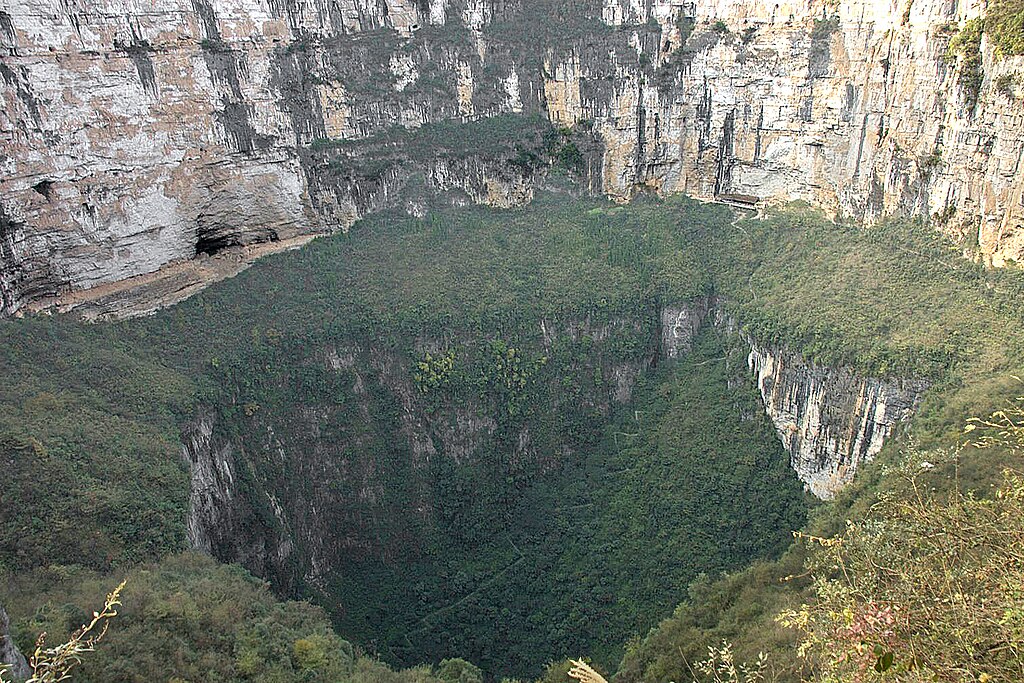
Imagine standing at the edge of a vast hole that could swallow the Empire State Building. A hole so deep that clouds form within its depths, with vertical walls plunging into darkness like a gateway to the center of the Earth. This isn’t science fiction—it’s the Xiaozhai Tiankeng, also known as the “Heavenly Pit,” the world’s deepest sinkhole in Fengjie County, Chongqing Municipality, China.
What makes this natural formation truly extraordinary isn’t just its size—though its volume of 119.349 million cubic meters (around 4.2 billion cubic feet) is staggering—but also the thriving ecosystem that has developed within its depths, hidden from the outside world like a scene from a lost world adventure.
Discovery of the Heavenly Pit

Though scientists only formally documented Xiaozhai Tiankeng in 1994 during the China Caves Project expedition, locals have known about this massive geological feature since ancient times. The name itself reveals its history—”Xiaozhai” refers to a now-abandoned village nearby and translates to “little village,” while “Tiankeng” means “Heavenly Pit” in Chinese, a regional term used explicitly for these massive sinkholes.
As knowledge of the Xiaozhai Tiankeng spread beyond local folklore and scientific papers, interest in this natural wonder grew. Today, a 2,800-step staircase constructed along one wall allows visitors to descend into the abyss, though the journey remains physically demanding. This infrastructure has transformed what was once an almost inaccessible natural feature into a destination that draws adventurous travelers worldwide.
The Staggering Dimensions of the Hole
The sheer scale of Xiaozhai Tiankeng is challenging to comprehend. With a length of 626 meters (2,054 feet) and a width of 537 meters (1,762 feet), its opening covers an area of 274,000 square meters—equivalent to about 38 soccer fields placed side by side. Its depth ranges between 511 and 662 meters (1,677 and 2,172 feet), making it deeper than two Eiffel Towers stacked on each other.
The walls of the sinkhole are nearly vertical, creating a sharp boundary between the world above and the hidden realm below. During the rainy season, water cascades over these walls, creating spectacular waterfalls that plunge hundreds of meters into the depths. The sound of this rushing water echoes throughout the enormous cavity, adding to the otherworldly atmosphere of this natural wonder.
How Was the Geological Marvel Formed?

The formation of Xiaozhai Tiankeng represents a perfect storm of geological conditions coming together over thousands of years. Unlike many other natural wonders that took millions of years to form, this massive sinkhole is relatively young—geological evidence suggests it formed gradually over the last 128,000 years.
The sinkhole sits atop thick layers of Triassic limestone—pure, solid blocks of carbonate rock with few impurities. This composition is crucial for tiankeng formation. When rainwater combines with carbon dioxide in the atmosphere and soil, it creates a weak carbonic acid. This acidic water slowly dissolves the limestone as it percolates through cracks and fissures, gradually hollowing underground chambers.
In the case of Xiaozhai Tiankeng, this process was accelerated by the mighty underground river that flows beneath it. This river eroded the limestone from below, creating the extensive Difeng cave system. Eventually, the ceiling of this cave became too thin to support itself, collapsing dramatically and creating the initial sinkhole. Over time, further collapses expanded the pit to its current massive dimensions.
The specific conditions needed to form a tiankeng like Xiaozhai are remarkably rare. The limestone must be above sea level, extremely thick, and relatively pure without layers of other materials. The area must also receive heavy rainfall to feed the underground river system that drives the erosion process. These precise requirements explain why true tiankengs are so uncommon worldwide.
Life Below the Surface

Flowing silently beneath the sinkhole is the mighty underground river that played a crucial role in its creation. This river begins in the Tianjin fissure gorge, traveling approximately 8.5 kilometers (5.3 miles) through darkness before emerging at a vertical cliff above the Migong River, creating a spectacular 46-meter (151-foot) waterfall.
During its underground journey, this river drops 364 meters (1,194 feet) in elevation. Its average flow rate of 8.77 cubic meters per second might sound modest, but during heavy rains, it can surge to an incredible 174 cubic meters per second—enough to fill an Olympic swimming pool in less than 15 seconds.
A World Within a World: The Unique Ecosystem
The most remarkable aspect of Xiaozhai Tiankeng isn’t its impressive dimensions but the extraordinary ecosystem that has developed within its depths. The sinkhole houses 1,285 documented plant species, creating a lush, primeval landscape that contrasts sharply with the world above.
Among these plants is the rare ginkgo biloba, sometimes called a “living fossil” because it has remained virtually unchanged for over 200 million years. These ancient trees, with their distinctive fan-shaped leaves, find refuge in the protected environment of the sinkhole, where the stable microclimate and isolation from human interference allow them to thrive.
The pit’s animal inhabitants are equally remarkable. The elusive clouded leopard, a vulnerable species with fewer than 10,000 individuals remaining in the wild, has been documented in the sinkhole. The Chinese giant salamander, the world’s largest amphibian and a critically endangered species, also makes its home in the clear waters of the underground river system.
This biodiversity exists because the sinkhole creates a protected microclimate. The steep walls shield the interior from strong winds while the depth stabilizes temperature. Moisture from the underground river system rises to create misty conditions perfect for many plants. This isolated environment functions almost like a time capsule, preserving species that might otherwise have disappeared due to human activity or habitat loss in the surrounding areas.
China’s Kingdom of Sinkholes
While Xiaozhai Tiankeng stands out for its record-breaking depth, it’s part of a more significant geological phenomenon. China is home to most of the world’s tiankengs, with 50 of the 75 identified worldwide located within its borders. This concentration isn’t coincidental but rather the result of China’s extensive karst regions—areas where the bedrock consists primarily of soluble rocks like limestone.
The abundance of tiankengs in China, particularly in Chongqing, Guangxi, and Sichuan, stems from the perfect combination of geological conditions. These regions feature thick limestone formations laid down during the Triassic period, elevated above sea level by tectonic activity, and subjected to heavy monsoon rainfall. This creates ideal circumstances for forming massive sinkholes over relatively short geological timeframes.
These formations have special cultural significance in Chinese history and folklore. Often depicted in traditional art and literature as gateways to other worlds or homes of supernatural beings, tiankengs have inspired generations of myths and legends. The name “Heavenly Pit” evokes this sense of connection between the earthly and the divine.
This spiritual dimension was very real for local communities. Fei Ge, who grew up near the sinkholes before becoming one of their first explorers, remembers: “We thought that if humans went into the sinkholes, demons would bring strong winds and heavy rain. We thought ghosts brought the mist and fog.” What scientists now understand as the unique microclimate created by these massive geological features—with wind rushing through tunnels and evaporated water from underground rivers creating mist—was once explained through supernatural beliefs that kept locals at a respectful distance.
Visiting the Heavenly Pit: Tourism and Conservation
For adventurous travelers, the Xiaozhai Tiankeng offers an unparalleled opportunity to witness one of nature’s most spectacular formations. The 2,800-step staircase winding its way down one wall allows visitors to descend into the abyss, though the journey requires good physical condition and proper preparation. Those who make the descent are rewarded with a perspective few ever experience—standing at the bottom of the world’s deepest sinkhole, surrounded by vertical walls that seem to reach the sky.
As tourism has increased, so have efforts to balance accessibility with conservation. The ecosystem within the sinkhole is fragile, and increased human presence poses potential risks to the rare plants and animals that call it home. Local authorities have implemented measures to limit visitor numbers and establish guidelines for responsible tourism. Educational programs aim to raise awareness about the site’s geological and ecological importance.
Dr Lina Shen, a leading sinkhole researcher based in China said “Hot air balloons, drones for aerial photography, and appropriate pathways for observation from a distance could allow tourists to closely yet remotely view sinkholes, while disturbing as few organisms as possible.”
Those who have visited often describe the experience as transformative. Standing at the bottom of the pit, surrounded by ancient trees, and looking up at a small circle of sky hundreds of meters above creates a profound sense of perspective. It’s a reminder of the Earth’s ongoing geological processes and the hidden wonders that still exist in our world.
The Mystery of Earth’s Hidden Depths
Even after decades of rigorous scientific exploration, the Xiaozhai Tiankeng, often dubbed the “Heavenly Pit,” continues to astound researchers with its enigmatic beauty and ecological richness. The depths of this immense sinkhole reveal a hidden world brimming with life, where scientists document a plethora of previously undiscovered plant and animal species that thrive in the darkness. Ongoing geological surveys meticulously unveil the intricate details of its formation and fascinating evolutionary history, offering insights into the Earth’s dynamic processes over millennia.
As our planet grapples with escalating environmental challenges, the significance of extraordinary locations like Xiaozhai Tiankeng becomes increasingly profound. These natural wonders serve as powerful reminders of the resilience and ingenuity of Earth’s ecosystems, showcasing the astonishing diversity of life that can flourish even in the most seemingly inhospitable conditions. They underscore the crucial necessity of preserving these majestic places for future generations, ensuring that their splendor endures.
The “Heavenly Pit” truly lives up to its ethereal name—a mystical realm where the lines between the terrestrial and the sublime beautifully blur. Visitors who descend into its heart are invited on a remarkable journey, emerging with a sense of awe and a deeper understanding of the enduring mysteries beneath our feet. It’s a humbling experience that sparks a profound appreciation for the natural world’s wonders and its secrets.
