
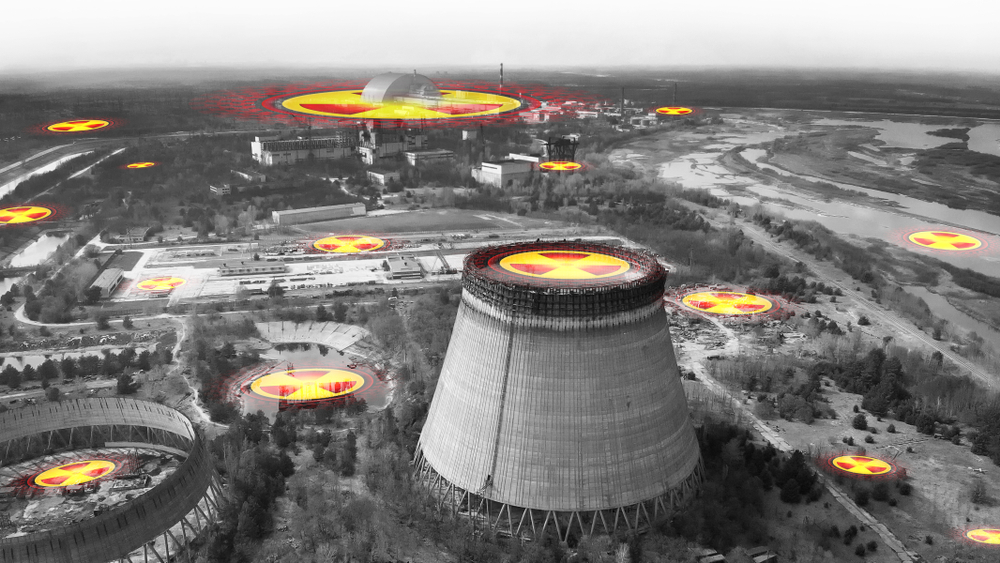
What if a disaster zone once deemed untouchable for 24,000 years could be brought back to life in just five?
For decades, Chernobyl has been frozen in time—a name synonymous with irreversible damage. Scientists wrote off the region as a radioactive no-go zone, a scar on the planet that would outlast generations. But something unprecedented is happening beneath its soil. Not with chemicals, bulldozers, or high-tech containment units—but with a silent, passive technology that accelerates what nature is already trying to do.
Radiation in the soil has dropped by 47%. In the air, by 37%. And it’s not a theory—it’s real, measured, and verified. A small company, using a network of underground tubes and a surprising particle from physics, has managed to shrink centuries of radioactive decay into a matter of years.
Here’s how they did it—and why it may rewrite how we think about environmental recovery altogether.
A Breakthrough in Radioactive Cleanup

For 35 years, Chernobyl has symbolized the kind of environmental damage that feels permanent. After the 1986 reactor explosion, experts estimated that the radioactive contamination would linger for tens of thousands of years. Entire communities were abandoned. The land was written off. Cleanup, beyond containment, was considered impossible.
That belief just changed.
On a one-hectare plot of land near the Chernobyl plant, radiation levels have dropped dramatically—47% in the soil and 37% in the air—thanks to a new technology developed by Swiss environmental company Exlterra. The system, called the Nucleus Separation Passive System (NSPS), was installed between 2019 and 2020 in partnership with Ukraine’s SSE Ecocentre, the agency responsible for monitoring Chernobyl’s exclusion zone. Within a year, it delivered results that no other radiation mitigation effort has achieved in over three decades.
Frank Muller, CEO of Exlterra, explained the significance of these findings: “This 12-month reduction in radioactivity will allow us to bring this parcel back to its original radioactivity level over a five-year period.” That’s a staggering shift from the original 24,000-year timeline projected for natural radioactive decay.
Importantly, the claims aren’t coming from marketing materials alone. The data was gathered and verified by Ukrainian radiation experts led by Sergiy Kireiev, General Director of SSE Ecocentre. “These results are remarkable,” Kireiev stated. “It is the first time in 35 years that such technology has succeeded in reducing the level of radioactivity in the soil and air so significantly.”
How the Technology Works

Most radiation cleanup methods rely on heavy machinery, chemical treatments, or containment strategies that disrupt the environment and require constant oversight. Exlterra’s solution takes the opposite approach—no digging, no chemicals, no electricity, and no maintenance.
At the core of the system is something called the Nucleus Separation Passive System (NSPS). It’s a network of specially designed polyethylene tubes buried underground. These tubes aren’t filled with anything. They simply act as conduits, tapping into natural forces already present in the Earth. Specifically, they harness positrons—high-speed subatomic particles that naturally exist in small amounts.
Here’s how it works, in plain terms:
- Positrons are like the mirror image of electrons. In the right conditions, they can collide with radioactive atoms such as cesium-137, strontium-90, and americium-241—the most dangerous leftovers from nuclear accidents.
- When a positron meets one of these radioactive isotopes, it binds with an electron and triggers a reaction that neutralizes the atom, converting it into stable matter.
- This happens safely and silently beneath the surface. There’s no release of radiation, no toxic byproducts, and no disturbance to the soil or surrounding area.
What makes this effective isn’t just the science—it’s the design. The tubes are placed at precise lengths and angles to concentrate and direct positrons toward contaminated areas. Once installed, the system runs on its own. It’s completely passive—meaning it doesn’t need power or active management to keep working.
Andrew Niemczyk, Exlterra’s co-founder and chief technology officer, puts it this way: “NSPS is an innovation that allows positrons to naturally accelerate in a passive system to remove contaminated areas. It uses natural energies to solve industrial pollution without resorting to chemical substitutes or soil manipulations.”
Real-World Results and Who’s Behind It

The claims behind Exlterra’s technology aren’t hypothetical. They’re backed by data collected under strict, independent monitoring protocols—and they mark the first tangible progress in Chernobyl’s decontamination since the disaster occurred.
The pilot project was carried out on a one-hectare plot inside the Chernobyl exclusion zone. NSPS was installed between November 2019 and September 2020, and measurements were taken one year later. The results were clear:
- 47% reduction in soil radiation
- 37% reduction in airborne radiation
These aren’t minor shifts. They represent a meaningful drop in contamination levels—enough to significantly accelerate land recovery. The radionuclides affected include cesium-137, strontium-90, and americium-241—some of the most persistent and dangerous elements released by nuclear accidents.
What adds credibility is who verified the results. The testing and radiation measurements were conducted by SSE Ecocentre, Ukraine’s state-run agency responsible for radiation monitoring in the Chernobyl zone. Soil samples were collected from a depth of one meter, and air readings were taken at multiple heights above ground to ensure accuracy. Sergiy Kireiev, General Director of SSE Ecocentre, said plainly: “These results are remarkable. It is the first time in 35 years that such technology has succeeded in reducing the level of radioactivity in the soil and air so significantly.”

Behind the technology is Exlterra, a Swiss environmental technology company co-founded by Andrew Niemczyk, a Polish-American inventor, and Frank Muller, its CEO. The company focuses on passive, sustainable solutions to industrial-scale environmental problems. While NSPS is their most high-profile project to date, Exlterra has developed other underground systems aimed at improving soil health, hydraulic pressure, and even tree nutrition—all without chemical input or mechanical disruption.
According to Muller, this early success is just the beginning. “We’re on track to return the installed zone to baseline or natural levels within five years,” he said. The company is now looking to scale the solution to other crisis sites, including Fukushima in Japan.
With field-proven results, verified by national radiation authorities, and driven by a team focused on sustainability over spectacle, NSPS is quickly becoming more than just a prototype—it’s a viable model for global cleanup.
Why This Could Change Environmental Cleanup

The NSPS system isn’t exclusive to radioactive cleanup. Its ability to break down stubborn contaminants using passive, nature-aligned processes opens the door to tackling other major pollution problems. That includes heavy metals and perfluoroalkyl substances (PFAS)—often called “forever chemicals”—which have contaminated water and soil across the globe. These pollutants don’t break down easily and can persist in the environment for generations. If NSPS can be adapted to target them, the environmental stakes could shift significantly.
Another key advantage is scalability. NSPS doesn’t require a power source, ongoing maintenance, or disruptive infrastructure. Once installed, it functions on its own—using only the Earth’s natural energies. That means the technology could be deployed in remote areas, crisis zones, or places where large-scale industrial cleanup isn’t feasible.
Exlterra’s leadership has already set their sights on Fukushima, where radioactive waste and contaminated water remain major threats more than a decade after the nuclear disaster. According to CEO Frank Muller, NSPS offers a potential alternative to the controversial release of radioactive water into the ocean. “We can avoid the discharge of radioactive water and thus prevent a new ecological catastrophe,” he stated.
And there’s a broader point here: this technology shifts the mindset from managing contamination to reversing it. Until now, most efforts have focused on containment—keeping pollutants from spreading or mitigating their effects. NSPS aims to neutralize the problem at its core.
As Exlterra co-founder Andrew Niemczyk put it, “We have demonstrated that we can use nature’s resources to heal the wounds we inflict on it.” It’s a model that doesn’t just clean up the past—it could help prevent long-term environmental damage in the future.
What This Means for the Rest of Us

You may not live near a nuclear disaster site, but the lessons from Chernobyl’s cleanup breakthrough have real-world relevance—even if your biggest environmental concern is tap water quality or local soil health.
Here’s what this technology—and its success—means for the rest of us:
1. Not all damage is permanent: Chernobyl was long considered a write-off—an uninhabitable zone frozen in radioactive time. Yet a 47% drop in soil radiation in one year proves that even large-scale damage isn’t always irreversible. That applies to the environment, but it also reshapes how we think about smaller-scale pollution in our own communities. Land can be restored. Contaminants can be neutralized. We’re not stuck with every mistake.
2. Technology doesn’t have to be destructive to be effective: NSPS works without disturbing the soil, adding chemicals, or using external power. That’s a model worth remembering. Just because a solution isn’t loud or visible doesn’t mean it’s not powerful. Sometimes, the most sustainable answers are the quietest—those that align with nature rather than overpower it.
3. Environmental solutions can be scalable and practical: This isn’t a lab experiment locked behind academic paywalls. It’s a functioning system that has already been field-tested and verified. Because it doesn’t rely on energy inputs or ongoing maintenance, NSPS could be deployed more widely and affordably than complex, high-tech systems that require constant oversight. That’s encouraging news for under-resourced areas and developing countries facing contamination.
4. Stay informed about local contaminants: While you may not be dealing with radioactive isotopes, substances like PFAS and heavy metals are widespread in soil and drinking water—even in urban areas. Technologies like NSPS could eventually offer safe, passive treatment options at the community level. Being aware of what’s in your water or soil is the first step toward advocating for or adopting solutions like these.
5. Support innovations that work with nature: Whether through policy, funding, or awareness, supporting environmental solutions that are passive, non-toxic, and scalable sends a message: we don’t have to keep repeating the same extractive, industrial playbook to solve modern problems. Real innovation respects ecosystems rather than treating them as obstacles.
This isn’t just about a patch of land in Ukraine—it’s about rethinking how we clean up, restore, and move forward. And that shift in thinking is something anyone can apply, anywhere.
A New Way of Thinking About Healing the Planet

Chernobyl was supposed to be a permanent wound—proof of what couldn’t be undone. But now, the ground is changing. Not because we overpowered nature, but because we finally started working with it.
The NSPS technology doesn’t just clean radioactive soil—it flips the script on what “cleanup” can look like. It proves that solutions don’t have to be invasive, toxic, or high-maintenance to be effective. And it reminds us that nature isn’t just a victim of our actions—it can also be part of the recovery, if we let it.
This shift isn’t just about environmental science. It’s about mindset. For too long, we’ve treated damage—whether to ecosystems, cities, or even personal lives—as something fixed in place. But Chernobyl’s quiet transformation shows us that with the right tools and approach, even the most contaminated ground can begin to restore itself.
So the question is: What other problems have we labeled as “permanent” just because we didn’t yet know how to fix them?
Maybe the future of healing—our planet, our systems, even ourselves—isn’t about force. Maybe it’s about alignment. Listening. Precision. And giving the forces that are already at work a better path to do what they’re meant to do.
Chernobyl’s story isn’t finished—but it’s no longer a dead end. And that’s something worth carrying forward.
