
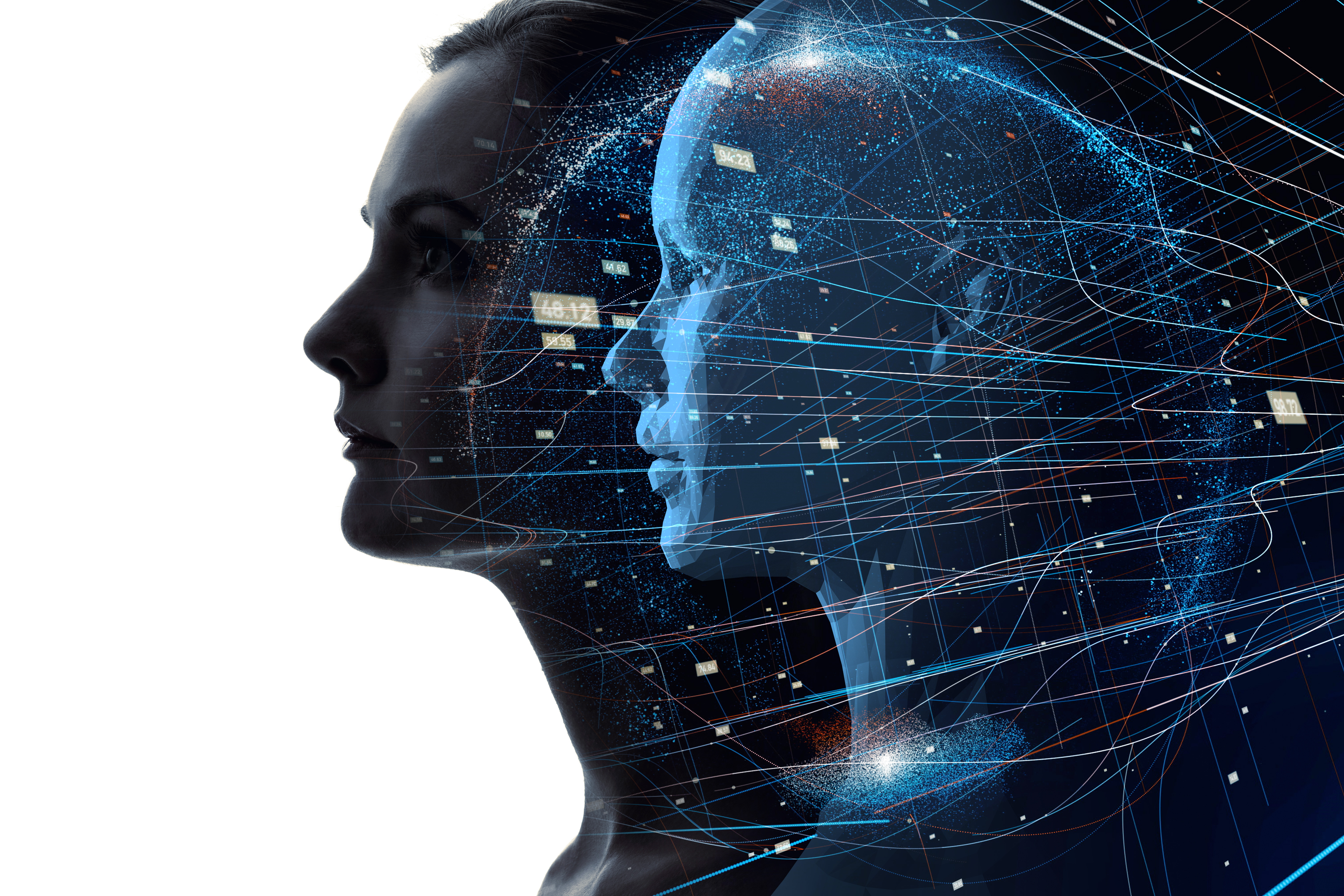
Chances are, you’ve scrolled past those wild AI images predicting what humans might look like in a million years. You know the ones—sleek, cybernetic beings with glowing eyes and bodies perfectly merged with technology. It’s fascinating stuff, but the critical question remains: Is that our actual destiny, or is it just AI re-hashing our favorite sci-fi movies?
Answering that question means moving past the hype to examine the powerful forces that are actually shaping our species’ future. This is an exploration of what real science says about where humanity is headed and, more importantly, what the choices made today mean for the humans of tomorrow.
AI as a Mirror: Why Futuristic Visions Reflect Our Past

To understand those futuristic images, it helps to know how they’re made. AI image generators are not prophets; they are powerful pattern-recognition systems. They are trained on huge datasets of images and text from the internet, meaning they learn from the culture we’ve already created.
Here’s the catch: the AI isn’t predicting the future so much as it’s reflecting our past. The cybernetic humans it creates are often an echo of the cyborgs we’ve already seen in movies, novels, and video games for decades. This creates a cultural feedback loop—the AI shows us what it thinks we want to see, based on what we’ve already imagined.
This process is also shaped by significant biases. Without specific commands to ensure diversity, the “default human” in many AI generations tends to be light-skinned, reflecting a historically dominant perspective in science fiction. The output can feel generic, often producing flawlessly smooth faces that lack the nuance of real human beings. These images, therefore, are less of a forecast and more of a mirror, reflecting our present-day hopes, anxieties, and cultural blind spots.
The Million-Year Makeover: How AI Predicts Our Future Form
AI models, like ChatGPT, have offered intriguing predictions about human evolution, extrapolating current trends and evolutionary principles.
Giant Brains, Tiny Jaws

One of the most striking predictions is the continued enlargement of our brains and skulls. As AI and complex problem-solving become increasingly central to our lives, larger craniums are theorized to evolve to accommodate ongoing brain development. However, this comes at a cost: our faces are expected to shrink dramatically.
Our jaws, already less robust due to softer, processed foods and supplements that require minimal chewing, will likely become even smaller. Think about wisdom teeth – once essential, now often removed because our modern jaws can’t fit them. This trend is predicted to continue until future humans have faces largely dominated by their braincases rather than an eating apparatus.
Bug-Eyed and Hairless

Prepare for a significant change in our ocular appearance. ChatGPT envisions future humans with enormous eyes, dominating their shrunken faces. This adaptation could be driven by living in environments with less natural light, such as space habitats or extensive indoor living due to climate control. Evolution prioritizes function, and large eyes would enhance low-light vision.
Another notable change is the complete disappearance of hair. From head to toe, future humans are predicted to be hairless. This could be a result of sophisticated climate control technology making hair for insulation obsolete, or perhaps even through gene editing to align with evolving aesthetic preferences. Given the billions we already spend on hair removal, it’s not a far stretch to imagine a future where we simply “switch off” hair production.
Stick Figures Come to Life as Muscles Disappear

While today’s gym culture emphasizes physical strength, AI suggests a future where muscles become largely obsolete. With machines handling nearly every physical task, human bodies are expected to adapt to a reality where physical exertion is minimal. This means slender limbs, delicate frames, and energy-efficient bodies replacing today’s more varied physiques. Why maintain calorie-burning muscle mass when automation performs all the work? This trend is already observable with the shift from physically demanding jobs to desk-based roles and increasing screen time over outdoor play.
One Shade Fits All: Humanity’s Universal Skin Tone

Geographic isolation once led to the diverse range of human appearances we see today. However, ChatGPT predicts a future where humanity’s skin tone becomes remarkably uniform. Global intermixing, international relationships, and migration are already blending populations. Over a million years, distinct regional features could merge. Additionally, living predominantly in artificial, climate-controlled environments under LED lighting removes the evolutionary pressures that led to different skin tones (e.g., dark skin for sun protection, light skin for vitamin D production in less sunny climates). This could drive convergent evolution toward a single, optimal pigmentation.
Giraffe Necks and Narrow Noses Beat the Heat

Climate change is also predicted to play a significant role in our future appearance. ChatGPT’s vision includes humans with elongated necks and narrower noses. Longer necks provide a larger surface area for heat dissipation, a crucial adaptation in a warming climate. Similarly, noses are expected to shrink and narrow. Large noses were once beneficial for warming and humidifying cold air. In a consistently warm world, this function becomes unnecessary, leading to smaller, more efficient noses that conserve resources while still filtering air.
These AI-generated predictions, while speculative, offer a fascinating glimpse into the potential long-term impacts of our current lifestyles, technological advancements, and environmental changes on the human form.
Evolution in Real-Time: What’s Happening to Our Bodies Now

If AI isn’t a reliable guide, what does actual biology say about our future? Human evolution hasn’t stopped; its driving forces have just changed. In the near term, one of the biggest drivers is simple demographics.
According to Dr. Jason A. Hodgson, a specialist in bioinformatics, global population trends are set to alter the human gene pool. He notes that populations in Africa are expanding more rapidly than in regions historically associated with lighter skin. Based on this, Dr. Hodgson predicts, “I’d expect that the average person several generations out from now will have darker skin colour than they do now.” This isn’t about adaptation to sunlight, but a direct result of which genes are becoming more frequent in the global population.
Another powerful force is urbanization. For the first time in history, most humans live in cities. These urban centers act as massive genetic melting pots, mixing populations from all over the world. Over time, this could lead to a “grand averaging” of our species, where distinct regional features become less common. At the same time, city life itself may be selecting for new traits, such as stronger immune systems to handle dense populations or enhanced stress resilience. These subtle but powerful forces are changing the human blueprint in real-time.
The Game Changer: Engineering Our Own Evolution
Natural forces like demographics and urbanization are not the only factors at play. As Associate Professor in Bioinformatics Thomas Mailund states, the question of our future evolution “is not really a biological question anymore, it’s technological.” We are moving from an era of evolution by chance to one of evolution by choice.
The most powerful of these tools is the gene-editing technology CRISPR. It can be used to correct the mutations that cause hereditary diseases like sickle cell anemia. However, the same tool that can fix a “broken” gene could also be used to “improve” a healthy one, leading to the controversial concept of “designer babies.” This possibility has ignited a fierce ethical debate. Jennifer Doudna, a co-inventor of CRISPR, has called for a “pause” on making heritable changes to the human genome, citing the risk of unintended consequences. Geneticist George Church frames it as a parental choice, but warns about the danger of social pressure, where a “choice” becomes an expectation.

Brain-computer interfaces (BCIs) are also blurring the line between human and machine by creating a direct pathway between the brain and an external device. While the initial goal is often therapeutic—such as restoring movement for people with paralysis—the long-term vision includes cognitive enhancement for everyone.
These technologies raise a critical social question. If access to powerful and expensive enhancements is determined by wealth, it could create a biological class divide between the “enhanced” and the “unenhanced.” This goes far beyond existing economic disparities, creating the risk of a permanent, biologically-enforced social structure. The power to engineer our evolution comes with a profound responsibility to ensure it doesn’t divide us.
Evolve Your Health: 3 Tips for the Modern Human

The forces shaping our species’ future offer powerful clues about how to optimize our health in the here and now. Instead of waiting for futuristic technology, you can use these principles to build a more robust body and mind today.
- Train your brain for complexity: The future may promise cognitive enhancement through technology, but you can work on building a better brain right now. In a world of constant information and distraction, focus on activities that build “cognitive reserve”—your brain’s ability to adapt and improvise. Go beyond simple brain games. Actively learn a new, complex skill like a musical instrument or a language. This forces your brain to create new neural pathways, improving memory, attention, and problem-solving skills in a way that passive entertainment cannot.
- Build resilience to modern stress: Our ancestors adapted to acute physical dangers, but we face chronic psychological stress from modern urban life. This constant pressure can degrade your health. The key is to build your resilience. Practices like mindfulness meditation are not just about relaxation; they are a form of mental training that has been shown to physically change the brain’s stress-response centers. Similarly, regular, intense exercise helps your body regulate its primary stress hormone, cortisol, making you less reactive to daily pressures.
- Take control of your gene expression: Gene editing may be the future, but influencing your gene expression is possible today. The science of epigenetics shows that your lifestyle acts as a set of instructions for your DNA. Foods rich in specific nutrients—like the sulforaphane in broccoli or the curcumin in turmeric—can influence the activity of genes involved in inflammation and cellular health. By focusing on a whole-foods diet, prioritizing sleep, and managing your stress, you are sending signals that encourage your body to express its healthiest genetic potential.
In an era of rapid change, taking deliberate control of your health is the most practical form of evolution.
Who We Choose to Become
For the first time in the history of life on this planet, a species—our own—can consciously direct its evolution. The future of humanity is no longer solely a matter of random chance and natural selection; it is increasingly a matter of deliberate choice, shaped by our technology and our values.
As we stand at this turning point, two distinct paths appear. One, driven by life on a connected Earth, could lead to a blended, more unified humanity. The other, driven by the ambition to live on other worlds, could lead to our fragmentation into new species. These are not decisions to be left to scientists in labs or entrepreneurs in boardrooms. They demand a broad, inclusive, and global conversation to ensure that these transformative technologies are developed responsibly and ethically.
Ultimately, the images of our cybernetic descendants force us to confront a deeper question. As we gain the power to re-engineer our bodies and minds, the focus must shift from what we can change to what we should value. The real challenge is not just to enhance our capabilities, but to enhance our humanity. The most important question is not what we will look like, but who we will choose to become.
