
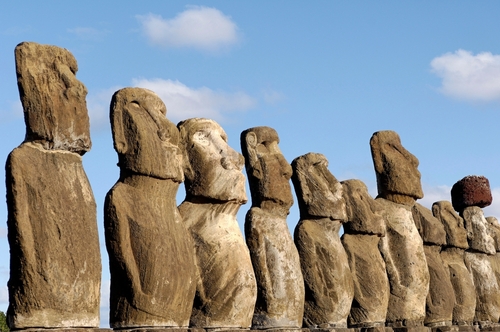
For centuries, the mysterious stone faces of Easter Island—known to locals as Rapa Nui—have captivated the imagination of explorers, historians, and everyday dreamers. Scattered across the island’s windswept plains and coastal ridges, nearly 900 of these colossal figures, called Moai, rise from the earth with silent majesty. To anyone who visits, they seem to belong to another world, relics of a civilization whose secrets were buried long ago beneath volcanic soil and ocean winds. Each statue can weigh anywhere from 12 to 14 tons, carved from compressed volcanic ash called tuff. They stand not as isolated monuments but as part of an entire cultural and spiritual landscape that once thrived on this small Polynesian island, far removed from any continental influence.
For generations, the question of how these statues were moved has puzzled scientists. How could a community without wheels, cranes, or even pack animals transport such massive structures over several kilometers of rugged terrain? Some early theories were imaginative but impractical—giant wooden sleds, earthen ramps, or even alien intervention. Yet none fit the physical or cultural evidence. The mystery seemed eternal. But new research has changed that story.
Archaeologists Carl Lipo and Terry Hunt, combining careful physics modeling with an understanding of local traditions, have revealed that the Moai may not have been dragged or rolled at all—they were walked. By recreating a full-sized replica and using only ropes and human coordination, the researchers found that with the right rhythm and teamwork, the statues could “waddle” upright across the land, swaying gently from side to side like living beings. The discovery not only solves an ancient puzzle but also offers a moving lesson in the balance between science, ingenuity, and spirit.
The Science Behind the “Walking Giants”
The experiment that changed everything began with an idea that sounded almost mythical: what if the Moai were meant to move upright, on their own “feet”? To test this, Lipo and Hunt’s team built a 4.35-ton replica statue and assembled 18 volunteers. Using three ropes—two attached to the sides and one to stabilize from behind—they began rocking the statue, gently pulling in alternating motions. To everyone’s astonishment, it began to move. Slowly at first, then with increasing grace, the statue advanced forward, balancing on its curved base as though alive. Within just 40 minutes, it had “walked” 100 meters across the field.
This wasn’t just a clever trick; it was physics in action. The Moai’s design includes subtle features that make the walking method possible. Each statue leans slightly forward, shifting its center of gravity so that a small tilt creates momentum. The curved base allows controlled rocking, while the elongated shape distributes mass evenly for stability. These design choices, likely intentional, mean that the statues weren’t simply works of art—they were engineered for motion. The heavier they were, the better they balanced, making it easier for the team to coordinate their pulls. The physics of motion actually favored the Moai’s massive size.
This scientific revelation also aligns perfectly with the island’s archaeological record. The ancient Rapa Nui roads, which stretch from the quarry to the coast, show patterns of wear that match the statue’s upright movement. These roads aren’t random—they’re gently curved, accommodating the natural rhythm of rocking statues. Archaeologists have found broken Moai along these paths, suggesting they fell during transport, not because they were dragged but because they were being “walked.” The consistency between experimental physics and physical evidence leaves little doubt that this was how the Rapa Nui transported their ancestors’ likenesses.

The Rapa Nui’s Harmony of Physics and Spirit
The Rapa Nui people didn’t build the Moai merely to impress; they built them to connect. Each statue represented a revered ancestor whose spirit, or mana, protected the community. Standing tall on stone platforms called ahu, these figures looked inward toward the villages, watching over their descendants. The act of carving and raising them was both technical and sacred, uniting the people in shared purpose. In this light, the “walking” of the statues takes on profound spiritual meaning. The ancestors didn’t just stand still—they traveled, upright and alive, to their final resting places, guided by the hands and hearts of their people.
This worldview transforms what we see as a feat of physics into a living ritual. The Rapa Nui likely chanted, synchronized, and moved together with deep intention, embodying the belief that life itself was an interplay of balance and energy. Their mastery of movement wasn’t just mechanical—it reflected their harmony with natural forces. The swaying of the statues mirrored the motion of waves, the pulse of the earth, and the breath of community life. To move a Moai was to reenact the rhythm of the world itself.
This balance between science and spirit shows a form of intelligence we often overlook. The Rapa Nui didn’t need written equations to understand equilibrium; they observed, adapted, and felt it through experience. Modern science now verifies what their intuition already knew—that the universe, when worked with rather than against, will move mountains—or in this case, statues. The story of the Moai’s movement reminds us that human innovation often emerges not from dominance over nature, but from collaboration with it.

Lessons in Balance, Teamwork, and Sustainability
Beyond the mechanics of movement, the Moai offer enduring lessons about cooperation and balance—values as essential today as they were 900 years ago. To make a statue “walk,” every participant had to pull, release, and adjust in harmony. One mistimed tug could send the entire figure crashing down. But when everyone moved as one, the statue glided forward effortlessly. It’s a perfect metaphor for human progress: when we align our actions with a common rhythm, the seemingly impossible becomes achievable.
Equally powerful is what this discovery tells us about the Rapa Nui’s relationship with their environment. For years, Western scholars portrayed them as a cautionary tale of ecological collapse, claiming they deforested their island to move the statues. Yet new evidence paints a very different picture. The walking method required no wooden sleds or rollers—only human energy and rope, likely made from local plants. Far from destroying their environment, the Rapa Nui demonstrated remarkable adaptability. They built a system rooted in sustainability and social cohesion, showing that great achievements don’t have to come at the planet’s expense.
In our modern world, where innovation is often equated with technology and consumption, the Moai’s journey offers a counterpoint. Progress doesn’t always mean faster or more complex—it can mean simpler, slower, and more aligned with natural rhythm. The Rapa Nui remind us that ingenuity thrives where community and ecology meet. When we move with awareness, whether in architecture, agriculture, or daily life, we too can “walk” farther with less strain. Their statues were heavy, but their method was light on the earth.

The Mystery Reimagined Through Modern Science
The rediscovery of the Moai’s movement has redefined how we view ancient knowledge. What once seemed primitive now appears deeply advanced—a fusion of observation, creativity, and understanding of natural laws. The Rapa Nui achieved feats that challenge modern assumptions about what “civilization” means. Without steel tools or written records, they mastered balance, geometry, and force with precision rivaling modern engineering.
Modern experiments have only deepened our appreciation for this achievement. When Lipo and Hunt scaled their method to larger models, the results remained consistent: the bigger the statue, the smoother it walked. It’s a rare case where mass aids mobility, a phenomenon that makes the Moai’s design all the more brilliant. Archaeological mapping further reveals that roads were carefully maintained, with overlapping sections suggesting staged movement—clear a path, walk a few meters, rest, then continue. It was a method of patience and adaptation, not conquest or exploitation.
This discovery also challenges how we think about progress. The Rapa Nui’s engineering was deeply integrated with their spiritual worldview, proving that science and belief can coexist without contradiction. Their approach to problem-solving was holistic—physical effort, communal coordination, and reverence for the land all working together. It’s a model of human potential that feels especially timely as we seek sustainable solutions for our own global challenges. The Moai’s “walking” isn’t just a relic of history—it’s a living lesson in humility and creative cooperation.
When Ancient Curiosity Meets Modern Wonder
What makes the Easter Island story timeless is how it bridges past and present. The Rapa Nui’s ingenuity shows that curiosity is our most ancient inheritance. Their understanding of physics, though not expressed in formulas, was empirical, tested by generations of hands and eyes that learned from the land itself. In rediscovering their method, modern scientists aren’t just explaining history—they’re rediscovering a lost dialogue between humans and nature.
In a world increasingly disconnected from its roots, the Moai invite us to remember that progress can still honor balance. Their journey from quarry to coast was one of patience, unity, and deep respect. The statues’ gentle “walk” across the island becomes a metaphor for mindful living—a reminder that slow, deliberate movement often gets us further than hurried ambition.
The solved mystery of how the Moai moved is more than an archaeological triumph; it’s a story about cooperation, sustainability, and wonder. It’s about how people, united by vision and respect for natural laws, can move mountains—or, in this case, giants of stone. The Rapa Nui’s wisdom continues to “walk” through time, reminding us that curiosity, community, and balance are not relics of the past but pathways to a more grounded future.
