
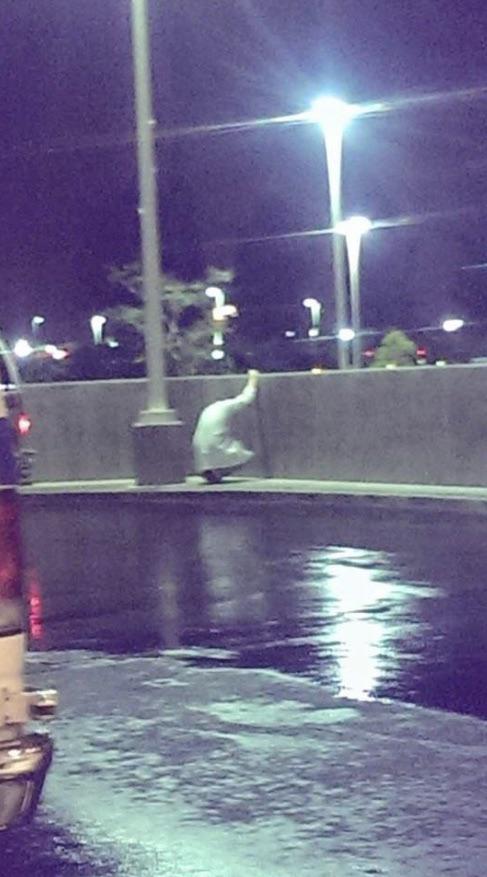
A grainy photograph taken outside a Southern California hospital has stopped millions of people in their social media tracks. The image shows an emergency room doctor crouched against a concrete wall, his body language speaking volumes about a grief too heavy to carry standing up. What happened moments before this photo would explain why this particular image resonated with people around the world, sparking conversations about humanity, loss, and the hidden emotional toll of saving lives.
The doctor had just lost a patient—not an elderly person at the end of a long life, not someone ravaged by chronic illness, but a 19-year-old whose death came unexpectedly. A paramedic, moved by the raw humanity of the scene, quietly captured the moment. With permission, the image made its way online, where it would soon remind millions that beneath the white coats and professional demeanor, doctors carry burdens most of us can barely imagine.
Within minutes of this photograph being taken, something remarkable happened. The doctor stood up, composed himself, and walked back through those hospital doors to continue his shift. This wasn’t just a moment of grief—it was a glimpse into the emotional marathon that healthcare workers run every single day.
A Doctor Steps Outside and Falls Apart
The photograph itself is simple yet devastating. An ER physician, still in his scrubs, sits crouched against the exterior wall of the hospital. His posture—head down, arms wrapped around himself—is universally recognizable as the shape of profound loss. The concrete wall behind him seems to be the only thing holding him up.
A paramedic who witnessed the scene felt compelled to document it, later explaining that this particular call was “one of those calls we get sometimes that just hits you.” The photo was shared by a coworker who was close friends with the doctor, ensuring permission was granted before the intimate moment went public. What followed was an outpouring of responses from around the world—thousands of comments, shares, and stories from people who suddenly saw their doctors in a new light.
The doctor’s own words about that night paint a picture of professional dedication intertwined with deep humanity: “I worked on him until he died and then I went outside and got down and cried and then I got up and went back inside and tried to feel better so I can make other people feel better.”
This cycle of work, grief, composition, and return occurs countless times in hospitals everywhere, often unseen by the patients and families who depend on these professionals to remain steady in the midst of the storm.
Why Losing Young Patients Hits Different

Emergency medicine professionals face death regularly. It’s an occupational hazard that comes with the territory of working in an environment where life-and-death decisions are made every minute. But there’s something uniquely devastating about losing a young patient that breaks through even the most seasoned doctor’s defenses.
An ER doctor identified as Smeee explained the hierarchy of difficulty in emergency medicine with brutal honesty: “Give me a bloody airway to intubate. Give me the heroin addict who needed IV access yesterday, but no one can get an IV. Give me the child with anaphylaxis. But don’t give me the unexpected death.”
The mathematics of grief in medicine often centers on expectations. When an 85-year-old with multiple chronic conditions doesn’t survive, there’s sadness but also a sense of life’s natural order. When a 19-year-old dies—someone who should have decades ahead of them—it feels like a fundamental betrayal of how things should work. These are the losses that follow doctors home, that wake them up at night, that make them question everything they thought they knew about saving lives.
Medical professionals often speak of certain patients who “stay with you.” These are typically the young ones, the unexpected ones, the ones who remind doctors that despite all their training and technology, sometimes they’re powerless against death’s arbitrary timing.
The Story Behind the Camera: What Happened That Night

The night this photo was taken started like any other shift in a busy Southern California emergency room. Ambulances arrived, patients filled the waiting room, and the controlled chaos of emergency medicine continued its usual rhythm. Then a 19-year-old patient arrived, and everything changed.
The medical team worked with the intensity and precision that comes from years of training and experience. Every protocol was followed, every intervention attempted. But medicine, for all its advances, has limits. When those limits are reached with a patient barely out of their teens, the weight of failure—even when nothing more could have been done—becomes almost unbearable.
The paramedic who took the photograph later explained that they felt compelled to capture the moment because it represented something rarely seen but universally felt in their profession. This wasn’t voyeurism, but recognition —a desire to document the humanity that exists behind the clinical façade of emergency medicine.
The image spread rapidly online, not as gossip but as revelation. One commenter attempted to capture the poetic weight of the moment: “And in the end, when the life went out of him and my hands could work no more, I left from that place into the night and wept – for myself, for life, for the tragedy of death’s coming. Then I rose, and walking back to the suffering-house, forgot again my own wounds for the sake of healing theirs.”
“Give Me Anything But the Unexpected Death”—What ER Doctors Feel

The response to this photograph opened floodgates of emotion from medical professionals worldwide. Doctors who had never spoken publicly about their grief suddenly found a space to share their experiences. Their stories painted a picture of a profession where emotional pain is as common as physical exhaustion.
One physician, identified as boldwhite, shared a particularly moving account: “I know what that person is feeling. Yesterday one of my 17-month-old patients died. I was in the bathroom crying in private between patients several times yesterday. I’ve cried in stairwells and hallways. It eats at you.”
These confessions reveal the hidden geography of hospital grief—bathrooms become sanctuaries, stairwells transform into private chapels, and empty hallways serve as spaces for the tears that can’t be shed in front of colleagues or patients. Each location represents a stolen moment where doctors allow themselves to feel the weight of loss before returning to the demanding pace of saving lives.
The physical spaces where doctors grieve tell their own story about the medical profession’s relationship with emotion. They’re always hidden, always brief, always followed by a return to duty. This compartmentalization might be necessary for functioning in high-stakes environments, but it comes at a tremendous personal cost.
When Crying at Work Gets You in Trouble

Perhaps the most troubling responses to the viral photo came from medical professionals sharing stories of being punished for showing emotion at work. The medical profession’s complicated relationship with grief became starkly apparent through these accounts.
One physician reported being cited for unprofessional conduct for crying at work, with her boss declaring, “Unless you are dying, crying is unprofessional behavior and not to be tolerated.” Another story involved a premedical student who witnessed a female physician crying after losing a child patient and judged her behavior as unprofessional—an attitude that suggests this emotional suppression is taught early in medical training.
The irony is palpable: a profession dedicated to caring for humans at their most vulnerable moments systematically punishes its practitioners for displaying their vulnerability. This culture of emotional suppression doesn’t create stronger doctors—it creates damaged ones who must find other outlets for their unprocessed grief.
Medical schools and hospitals are beginning to recognize this problem, but change comes slowly to institutions built on tradition. The photo of the crying doctor challenges this status quo by showing that real strength might lie not in suppressing emotion but in feeling it fully and still returning to help others.
What Happens After the Tears: The Part Nobody Talks About
The most powerful response to the viral photo came from a Reddit user with the memorable username PM_YOUR_PANTY_DRAWER, who painted a vivid picture of what happens after a doctor processes their grief:
“The part most people fail to realize, is that this man now has to compose himself, walk into another person’s room, and introduce himself with a smile and handshake to the next person. Sometimes healthcare workers walk in to see someone new and before even introducing themselves, out comes; ‘We’ve been sitting here for 45 minutes and…’ or ‘That guy next door has been moaning forever and nobody is helping him.'”
This jarring transition from profound loss to mundane complaints represents one of the most challenging aspects of emergency medicine. There’s no buffer zone between tragedy and routine, no time to process before moving on to the next patient who might be angry about wait times while the doctor is still carrying the weight of a life they couldn’t save.
Why This Photo Matters More Than You Think
The viral image of the grieving doctor represents more than just one difficult night in one emergency room. It’s a window into a crisis within the medical profession that has life-or-death consequences not just for patients but for doctors themselves.
Dr. Pamela Wible, who has become a leading voice on physician mental health, shared devastating statistics about the cost of suppressed grief in medicine. She revealed that both men she dated in medical school died by suicide—one overdosed at a medical conference, the other after work. In just over a year, her town lost three physicians to suicide, mostly by gunshot wounds. One local doctor had lost seven colleagues to suicide.
The connection between forbidden grief and physician suicide is more than a correlation. When professionals aren’t allowed to process the natural emotions that come with regularly witnessing death and suffering, that pain doesn’t disappear; it metastasizes—some turn to alcohol or drugs, others to more permanent solutions.
The doctor in the photograph, by allowing himself to grieve openly—even if briefly, even if outside—models a healthier approach. His five minutes of tears might have saved him from years of suppressed trauma. His willingness to acknowledge and fully feel his pain before returning to work demonstrates true professional strength: the ability to remain human in an often dehumanizing system.
Featured Image Source: Reddit
