

When Argentine police officer Celeste Ayala reported for duty one ordinary August day in 2018, she could never have imagined that a simple act of compassion would resonate across the globe. Stationed at the Sor Maria Ludovica children’s hospital in Buenos Aires, Ayala noticed a baby crying uncontrollably, a sound that pierced through the noise of her shift. The child, according to CNN, had been brought in by social services after being removed from a home suffering from extreme neglect and poverty. The infant was filthy, starving, and inconsolable.
Moved by instinct and empathy, Ayala asked for permission to hold and feed the baby. Without hesitation, she began breastfeeding the child herself, a spontaneous, human gesture that stunned her colleagues and soon captured the hearts of millions.
Her act was not a planned display but rather a raw, instinctive reaction to a child’s suffering. In that moment, Ayala bridged the gap between her role as a law enforcer and her role as a mother, proving that compassion can thrive in the most unexpected places. What made her gesture so moving was its simplicity; in a world where bureaucracy often defines action, she chose humanity.
The Viral Image That Captured Humanity
A fellow officer, Marcos Heredia, discreetly took a photo of the moment and shared it online with a caption praising Ayala’s compassion. The image quickly went viral, circulating on social media platforms and news outlets worldwide. In the photo, Ayala sits in uniform, cradling the baby in her arms, her expression calm and nurturing, a powerful contrast to the chaos that had defined the child’s short life.
I noticed that he was hungry, and I could feel it was a moment where I had to act, Ayala told local media later. She was a mother herself and said her maternal instincts simply took over. For many, it was a reminder that empathy often transcends duty, uniform, and circumstance.
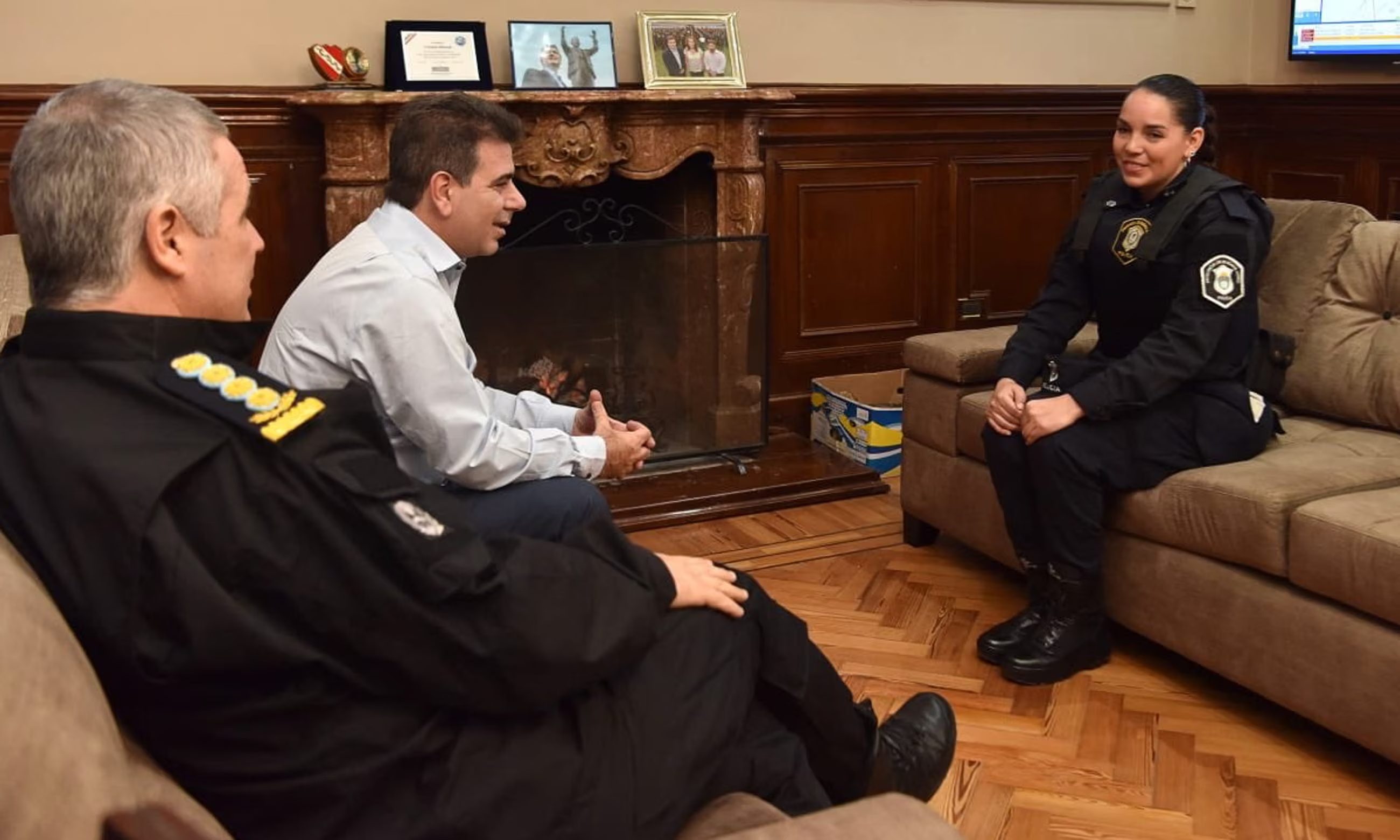
Later it was reported that Ayala’s selfless act was formally recognized by the Buenos Aires provincial police department. She was promoted from officer to sergeant in a special ceremony, applauded for her humanity as much as for her professionalism.
Her photo became a timeless symbol shared in parenting groups, police forums, and humanitarian pages. The reaction was universal admiration. In an age dominated by cynicism and outrage, this one image managed to restore a collective sense of faith in simple human goodness. It was proof that the smallest act of kindness could spark a global wave of emotion.
A Symbol of Compassion in a Hard Profession
Policing is often associated with discipline, enforcement, and resilience, not nurturing. Yet Ayala’s action flipped that narrative on its head. Her story became a symbol of compassion within a profession frequently seen as emotionally guarded.
The Buenos Aires Ministry of Security described her as someone who acted from the heart. According to The Guardian, provincial minister Cristian Ritondo personally congratulated her, saying, “You did not care about dirt and smell, you acted as a mother, not as a cop.”
For many Argentines, the story was not only about an officer doing something extraordinary but also about what humanity looks like when compassion overrides protocol.
Ayala’s act also sparked internal discussions within law enforcement circles about emotional intelligence and empathy in public service roles. It challenged outdated notions of strength and professionalism, suggesting that true courage lies in showing compassion even when it defies expectations. Many officers later admitted that her story reminded them of why they joined the force in the first place—to protect, to serve, and to care.
The Health Perspective: Why Breastfeeding Matters
Beyond the emotional resonance of Ayala’s story lies a critical health conversation. Breastfeeding, according to the World Health Organization (WHO), provides essential nutrients, antibodies, and emotional security vital for a child’s development, particularly in early infancy.
The Science Behind Breastfeeding
- Nutritional Value: Breast milk contains the perfect balance of proteins, fats, and carbohydrates that adapt to a baby’s changing needs.
- Immune Protection: It delivers antibodies that protect infants from infections and diseases, something formula feeding cannot fully replicate.
- Bonding and Comfort: The act of breastfeeding itself, skin-to-skin contact, rhythmic breathing, and warmth has been shown to regulate an infant’s heartbeat, reduce stress, and foster emotional security.

In emergency or impoverished conditions, breastfeeding can be lifesaving. A UNICEF study found that exclusive breastfeeding for the first six months can reduce infant mortality by up to 13%. In situations where hygiene, nutrition, and safety are compromised, as in the baby’s case that day, the benefits are immediate and profound.
Experts at UNICEF further emphasize that breastfeeding in crisis situations helps stabilize a child’s metabolism and prevents dehydration. In contexts of neglect or famine, a single feeding session can drastically improve an infant’s physiological stability. Ayala’s quick thinking may have not only soothed the child emotionally but also provided life-saving nourishment that day.
Maternal Instinct: A Psychological Insight
From a psychological lens, Ayala’s spontaneous act exemplifies the innate human drive to nurture. Maternal instincts are not bound strictly to biological relationships; they’re deeply rooted in empathy, hormones, and the mirror-neuron system that enables us to feel others’ distress as our own.
Neuroscientists explain that oxytocin, often called the “love hormone,” surges during breastfeeding, fostering both maternal and prosocial behaviors. It’s the same hormone linked to bonding and caregiving, evidence that compassion is, in fact, part of our biological wiring.
Ayala’s action demonstrates how empathy can override social norms or occupational boundaries. She didn’t see a case file or a duty roster; she saw a hungry child. And that simple shift in perspective sparked an act of humanity the world couldn’t ignore.
In addition to its emotional depth, her act also sparked scientific curiosity. Experts in developmental psychology noted how non-biological caregivers can trigger nurturing instincts identical to maternal ones. It showed that the capacity to care transcends biological ties, offering new insight into human empathy and shared emotional cognition.

Lessons Beyond the Uniform
Ayala’s story rippled far beyond Argentina. It reignited global discussions on public service, maternal care, and the intersection between empathy and professionalism. Her example encourages a broader understanding of what it means to serve, that compassion is not a distraction from duty, but often its purest form.
For working mothers, the story also shed light on the challenges of balancing professional roles with natural caregiving instincts. It reminded institutions that policies supporting motherhood, from breastfeeding breaks to child care access, are not luxuries, but necessities that uphold both health and humanity.
Her act has since inspired social campaigns across Latin America advocating for breastfeeding awareness and maternal rights. Police and military organizations cited her as a case study in empathy-led leadership training. In essence, she became a living symbol of how emotional intelligence could reshape professional culture from the inside out.
A Reflection on Humanity and Health
In the aftermath of her viral fame, Ayala’s humility stood out. She insisted that she had done nothing extraordinary. Yet her story endures as a gentle but powerful reminder: small acts of empathy can save lives, and in moments of crisis, humanity remains our greatest strength.
From a health perspective, it underscores how essential nurturing and nutrition are to survival and development. From a human one, it shows how compassion transcends roles and ranks.
In a world often overwhelmed by conflict and division, Officer Celeste Ayala’s quiet moment of care is a call to action, to remember that sometimes, the most heroic thing we can do is simply to be human.
Her legacy continues to inspire healthcare workers, parents, and public servants alike. Her story serves as a bridge between compassion and science, emotion and practicality. It reminds us that the line between heroism and humanity is often drawn not in grand gestures, but in the simple, instinctive acts of kindness that heal others.
